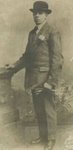

London 1904

Showing posts with label F.A.I.. Show all posts

Saturday, 30 June 2007

63. 1916 February


On one February morning F.A.I.s nephew
Sidney Davis (aged 5) went out to play and
did not return.

Several newspaper articles were retained by his mother
Ethel and latterly by his sister Babs, which describe the search.


HAMPTON- CHILD MISSING -Widowed Mother's Increasing Anxiety

Much anxiety is felt concerning the mysterious disappearance of a little boy named Sidney Davis, aged 5, the son of Mrs Davis, a widow of the River Tearooms, 23, Church Street, Hampton.
The little fellow left his home about 10 o’oclock on Monday morning to play, and is stated to have been last seen a little later going in the direction of Hampton Court with another little boy somewhat bigger than himself. Little Sidney Davis was a very intelligent child for his age. He was full faced, of fair complexion and was wearing a grey tweed overcoat, red jersey, brown cloth knickers, grey socks, high laced boots, red cap with two tassels, grey woollen gloves and a white scarf.The missing child is said to have been fond of playing near the river, and it is thought that he might have gone on the recreational ground for that purpose. The river has been dragged, but without result.
The police and Boy Scouts have made an exhaustive search of the district, including Bushy Park.

BOYS STORY OF MISSING CHILD
A statement supporting the theory that the little child, Sidney Davis, who has been missing since Monday in the last week, has been kidnapped, has been made by a boy named Greengrass, aged 13, of 19, Malvern Road. The boy who is the son of a local police constable, and knows the missing child well, declares that about one o’clock on the day on which he was missed he saw him near the entrance of Bushy Park, opposite the recreational ground, in the company of a woman, who also had with her another little boy aged about seven.
The woman who was of medium height and of dark complexion, appeared to be amused at some antics the missing child was going through at the time. On going back about 10 minutes later in order to give the little fellow a ride home on his bicycle he found that he had disappeared and also the woman and the other child. Greengrass who belongs to the Church Lads Brigade, was very much attached to the missing child and had recently taken part with him in a childrens performance in connection with the Church Sunday School. The boys statement was communicated to the police, who, however, do not attach any importance to it.


He was found eventually tragically he had drowned in the Thames. I don’t think that the whole circumstances surrounding his disappearance were ever fully known?

His mother and his sister remained in London for a few years after this tragic event but with siblings already over in Australia a decision to break with past griefs and to make a new life was made.

‘Only graves here’ Ethel was known to have said.


The booking to leave Britain was made but it took a whole year to hear if they were going. In notes made by Babs many, many years later in Australia she recalls

‘we spent a lot of time with a good brother and wife in Liverpool – my favourite Uncle F.A.I.’


Babs died just a couple of years ago, she had a full long life in Australia.
Her family brought her ashes home to rest in London alongside her dear brother ‘Siddy’


(Many thanks to PM and her family for the information)

In tender memory of our beloved Siddy,

Who passed away February 24th 1916

Aged 5 years

"Adieu sweet flower nipped in the bud, so loving sweet & fair"

"Lost a while our treasured love, gained forever, safe above"

Two desparately tragic deaths in the family at the start of 1916

Friday, 8 June 2007

11. 1912 February

On the 13th February 1912 F.A.I. sailed out of Liverpool on the R.M.S. Ivernia headed for Boston. He was working this time as 3rd Cook. His return was to Liverpool on 7th March.


R.M.S. Ivernia was launched in 1899 and was built for Cunard by C.S. Swan & Hunter,
Newcastle.
Ivernia's funnels, at 106 feet (32.31 m) above the main deck (and those of her sister, Saxonia) were the tallest single funnels ever installed on an ocean liner.
Her maiden voyage was from Liverpool to New York, on 14 April 1900 and in June 1900 she

was placed on the Liverpool-Boston route for which she was originally intended and remained on that route until December 1911.

Research I have suggests that the Ivernia was then placed on a Trieste-New York route and remained there until World War I, except for the winter of 1912-13, when she returned to the
Boston-Liverpool route but I have F.A.I. on there in February 1912 to Boston!
She was taken over as a troopship in September 1914.


On New Year's Day 1917 the Ivernia was torpedoed and sunk by a UB-47 off Cape Matapan, Greece, with 2,400 Scottish soldiers on board. 85 soldiers and 36 crew were killed.


As this was his first ship of 1912 I thought it apt to add the first poem in the book.


Upon The Road to Memory

Upon the road of memory I lingered long today
And of the things that I did see upon that precious way
A little chef with dark brown eyes with others came along
He was not big or very wise but happy was ‘is song
He sang of days that were to come when he should become a man
They made a truly wonderous sum the things he that he planned
And then he spoke his voice was kind
His words- ah! They were very good
He whispered softly ‘never mind
We’ve done the best we could’
But when he looked me in the face I was with a willful eye
Then turned and gazed far into space and gave a little sigh
For on the road to Memory
That leads to yesterday
He was the lad I used to be
Before my locks were grey

FAI 1912

10. 1912 (The Writer Appears)

During 1912 F.A.I. was at sea from February until New Year 1913. It would seem he did more or less back to back sailings.

This was the year of the sinking of the Titanic on 14th April on her maiden voyage to New York. F.A.I. had returned from New York on the 3rd April on the Franconia and spent the rest of April on land (it would seem) before sailing out again across the Atlantic to Boston.

Can you imagine what it would have been like at that time with such an event having just taken place? I wonder if he lost his nerve for a while or maybe sailings were curtailed?

Also that year he sailed on the Lusitania and the Carpathia. I heard tales as a child that granddad had been on the Carpathia at the time of the sinking of the Titanic
(probably not true… unless we have a missing entry from his discharge book). Recently I heard another tale that he missed the sailing from New York on the Lusitania on the very day it was torpedoed on 7th May 1915. Again there are no entries in his discharge book for 1915 and feel this is another fanciful tale of my dear Granny. (Lucky for me anyway as I may not have been here to write about him).

So the entries for 1912 will be many, mostly containing his poems and snippets about the ships on which he sailed. A lot of the works are not dated, the early ones I have taken as 1912 and later ones where his writing has changed and is similar to dated pieces I have taken them as being of that year.


The Book

Thursday, 7 June 2007

9. 1911 (& The High Seas)

One of the gems Granny saved was F.AI.s Seaman's Discharge book. Through this I have been able to follow his life through a few goods years. Thanks to the help of my brother and the Liverpool Maritime Museum (one of my top 10 museums) we have gathered together photographs and snippets of information about the ships he served on. In the discharge book he is described as being born in London in 1884, 5 foot 7 inches tall, grey eyes, brown hair, medium complexion and no tattoos or distinguishing marks (I wonder if he came back with any tattoos though?)

Obviously he spent long days at sea and the first evidence of his writing is found during his sea faring years.
The first ship he is recorded on was the 'Dakar' . He sailed out of Sierra Leone West Coast of Africa to Liverpool on 15th February 1911. He arrived back in Liverpool on 27th February 1911. He is noted as an Assistant Cook. How he got to Sierra Leone will remain a mystery but he probably went out on the Dakar.

The Dakar was built in Middlesborough in 1898 and was owned by Elder Dempster Lines. She was launched on 12th December 1898 as the "Clarence" for an African State Service Company, there she was renamed the "Anversville".

In May1899 she was delivered to Cie Belge Maritime du Congo into the Antwerp- Congo Free State Service. By March 1906 she had been transferred to African State Sevice and renamed as the Dakar.
On 15th February 1913 she collide with a Norwegian ship lying 15 miles south-west of Eddison Lighthouse and she was returned to port. Disaster stuck again on 31st March 1915 when her bunkers caught fire at Forcados. The fire caused a cargo fire an she burnt out amid ship. The wreck was taken over by the shipping controller and the usual war time compensation was paid out.
Circa 1919 -1920 she was salvaged and sold as a cargo vessel.
From 1922 she was renamed again, she became ammunition's ship for the Royal Navy in 1940 (out in Ceylon) and she ended her days in Karachi where she was broken up in 1947.


Dakar Hildebrand Vandyck
F.A.I.s next 2 trips were to Paraguay on board the 'R.M.S.Hildebrand' here he was a vegetable cook (don't know if this was promotion or not!!) These trips too 2 months to complete so from 16th April 1911 to 23rd August 1911 he went on back to back sailings.
The Hildebrand was built by Scotts Shipbulding & Engineering Co. Ltd., Greenock and she was launched on 14th February 1911. She set sail on her maiden voyage 1st April 1911 from Liverpool for Le Havre and Manaus. So when F.A.I sailed on her she was a brand new vessel.
On 5th December 1914 she was commissioned as an Armed Merchant Cruiser and became HMS Hildebrand of the 10th Cruiser Squadron
On 2nd October 1917 she was missed by a torpedo from a German Submarine which sunk the cruiser HMS Drake instead.
She was decommissioned on 17th January and returned to Booth Line
In February 1934 she was sold for £11,000 and broken up by J. Cashmore of Newport, Monmouth.
His final trip in 1911 was on the 'R.M.S. Vandyck'. He sailed out of Liverpool on 5th October 1911 for the River Plate, Buenos Aires returning to Liverpool on 11th December 1911. This time he was a second cook, (now that would appear promotion!)
The R.M.S. Vandyck was built by Lamport & Holt Shipping Line, Belfast in 1911. She was launched on 1st Jun 1911 and carried her first passengers to new York in the August. In September 1911 she did New York -Rio-Monte Video-Buenos Aires, so I imagine on her return to Liverpool my granddad's trip was next.
She was unfortunately intercepted on 26th October 1914 on passage to Buenos Aires by a German light cruiser, The Karlsrusche, just off St. Paul's Bay.
The next day the passengers and crew where transferred to a German supply ship . The Ascuncion. 4 days late the Ascunsion was detached and sent to Paraguay, with that the Vandyck was sunk by explosives.
What an adventure for first year at sea !


Saturday, 26 May 2007

2. His Background

F.A.I. was born in Upton, West Ham in early 1884. He was the 3rd of 9 children (Edward Charles, Emily Caroline Ethel, F.A.I., Mabel Mary Josephine, Ivy Louise, Arthur St John, Albert Cecil Anthony, Maud St Francis and Florence St Agnes).


There is no trace of him or his family in 1891. I guess they either opted out or were out of the country at the time. In his writing he has mentioned Ireland as his 'home land', maybe they were over there at the time. Certainly his sister Ivy moved to the Emerald Isle in the early 1900s.


In the 1901 Census he was noted a lodger, living with his brother Edward in London and was working as a 'potman'.

The family had dispersed by this time as his mother Caroline had died a few years earlier following the birth of Florence. She was 41. Obviously his father (also Edward) was not modern dad and didn't care to raise his children.

The 3 younger girls were placed in St Melltus Franscian Convent, Hanwell and the 2 older girls were working and lodging in a tobacconists, Albert had died shortly after he was born. There is no sign of Arthur or their father in 1901.


According to the wedding certificate, his father was originally a Tea & Wine Merchant, working I suspect with 3 of his brothers (Augustus, Albert and Arthur.. the 3A's) who were noted through the census returns as Wine Merchants. I often wonder if after his time in France, their father didn't happen to secure a few good business deals of fine French wines for his boys.
Later his father, was noted as a school master and with each of his sibling's births came a different address ...... Upton, Walthamstowe, Hackney, Plaistow and Mile End.


F.A.I.'s paternal grandfather was a Professor of Languages and a Linguist, born in Dorset. In fact I think he was given the longest profession description ever in the 1861 Census;


'Assistant Master of the Bangor Endowed School, Professor of the French Language & University Graduate of the University of France'


Around 1834/5 he and his wife Caroline, moved to Brest in France. (what a journey that would have been!) Here is where he obviously learnt his trade. They had 6 of their children there and in 1847 they returned to the UK and a further 5 children were born. (what an even harder journey that would have been with 6 children in tow)


Although F.A.I.'s paternal Grandparents had died by the time he was born, he would certainly have grown up in an interesting family environment, having French Aunts and Uncles who were also teachers and it naturaly follows an educated enviroment too!

My dear Granny, told tales of Grandads mother, Caroline, being a French lady and a school teacher, also that her father was a wealthy merchant and she had been swindled out of the family fortunes by a wicked step mother whilst away at Boarding School in Switzerland!!
Part of the tale is true .... she was called Caroline.
She did, however, have an unusual middle name of Berenger (quite posh) and she had sister-in-laws who were indeed French and teachers, but alas she was illegtimate and I have no way of tracing her father.


So that is a brief background to F.A.I.'s start in life...............dragged around London by an educated father and hearing tales of life in France.

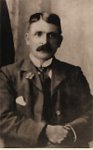
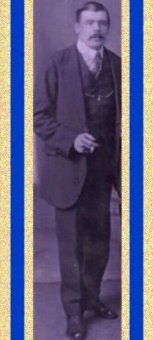
F.A.I.s Grandfather